


My experience interning at Pro Eco Azuero
Updated: Aug 19
By Isaac Barsoum
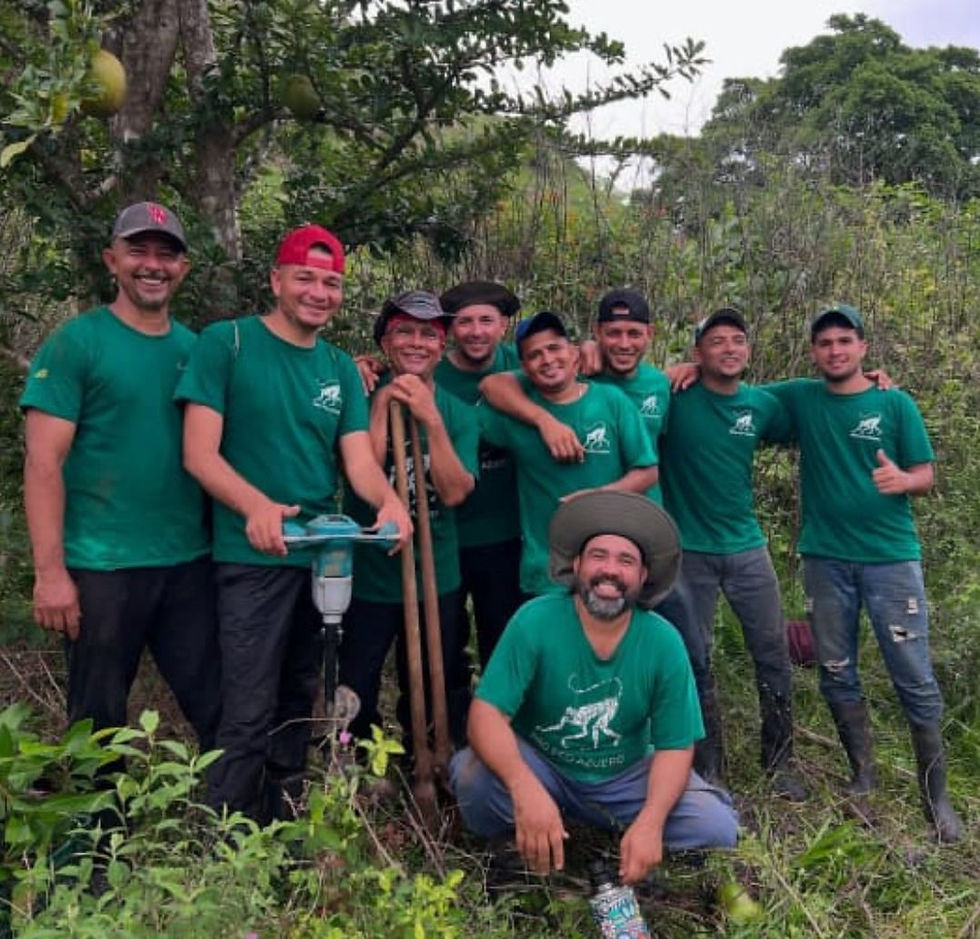
Before June 16, 2026, I had never planted a tree. On that day, I joined Pro Eco Azuero’s Equipo Mono (Monkey Team), and thus began my time working on critical reforestation work in Panamá. Throughout the course of the reforestation season, Pro Eco Azuero would plant thousands of trees in more than a dozen reforestation sites across the Azuero, empowering communities, protecting water resources, and restoring critically endangered habitats. At the same time, we carried on the essential work of environmental education, helping to bring up a new generation of santeños who know and care about the environment, climate change, and the habitats in which they live.

With a guabita cansaboca (Inga punctata) tree I planted in Venao.
It is often easy to become dismayed by the state of climate progress in the United States. As the world becomes hotter and drier and stormier, year after year, I watch my government tear apart climate regulations, reverse measures to build clean energy, remove protections for pristine wilderness, expand fossil fuel production, and fight never-ending wars for oil in the Middle East. Although other countries continue to make progress, from the perspective of the United States, it’s easy to feel hopeless.
But when I joined Pro Eco Azuero this summer, I began to regain hope. In the face of insurmountable odds — just eight percent of the tropical dry forest in the Azuero remains, and much of Panama’s forest has been lost over the last 70 years — Pro Eco Azuero works on, day in and day out. In this work there is a faith in the ability of ordinary people, working together, to, quite literally, change the course of history. There is a faith in our ability to restore habitats, build climate resilience, and reforest long-deforested land, all while engaging with and benefiting local community members who depend on the land for their way of life. While my country gives me despair, the work that Pro Eco Azuero does — and that I was lucky enough to participate in for eight weeks this summer — gives me so much hope.
My first day at Pro Eco Azuero, I woke up at 5 a.m. and helped load 500 plants into crates to be transported to the reforestation site for the day, in Oria Arriba. It was pouring rain, and I put on a pair of rain boots and resigned myself to dampness. The rain didn’t let up once we got to the day’s finca with the crates and stood a distance away from the large palm tree to protect ourselves from any lightning that might come our way. When we packed dirt into the holes around the newly-planted trees, pressing down on the soil pushed out the water that had filled the holes. Along with a group of volunteers from California, we planted 500 trees by 10 a.m. and returned to Pedasí for a traditional Panamanian lunch.

The first finca we planted during my time at PEA, in Oria Arriba. Though you can’t really tell in the photo, it was pouring rain.
I was covered in dirt and soaked to the bone. And I spent the rest of my summer wishing that I would be once more. In an extremely dry year, Pro Eco Azuero kept planting, hoping for rain. We planted on a mountain overlooking the ocean in Venao, on a hectare of pasture in Paritilla, on the side of a hill in La Mesa de Macaracas, along the sides of a creek in La Paula. We set up an agroforestry system in Los Pozos and replanted dead trees at a site Pro Eco reforested last year.
I got to learn about the different types of native trees from Jairo, César, and Leo. I now know that the fastest-growing tree is gallinazo (Schizolobium parahyba), which some reforestation organizations plant as monocultures. I know that cocobolo (Dalbergia retusa) is valuable timber. I know that the spider monkey’s favourite fruit is jobo (Spondias mombin), which is acidic, medicinal, and delicious for humans, too. I know that cacao (Theobroma cacao) likes to grow in the shade. I know how to identify dozens of different native plants, from nispero (Manilkara zapota) to lluvia de oro (Cassia moschata) to zorro (Astronium graveolens) to guachapalí (Samanea saman). I still struggle sometimes — but I will always try — to distinguish between the leaves of tamarindo (Tamarindus indica), cañafístula (Cassia grandis), macano (Diphysa americana), and frijolillo (Albizia adinocephala).

A gallinazo sapling in the tree nursery.
I learned about the history of the Panamá Canal, U.S. neocolonialism, the settlement of the Azuero, the Cobre Panamá mine, and more from Sandra. I listened to stories and music with César on long drives in his big Land Cruiser. I got to teach a lesson about food webs, focusing on the critically endangered Azuero spider monkey, to the Pro Eco Pelaos, with lots of help from Cinthia. I talked to Fernando about food, and language, and AI, and everything in between. I followed (and watched) the World Cup with Pincho. I helped translate between Spanish and English so that Roxana (and local community members) and a pair of employees from Plant for the Planet could communicate about Pro Eco Azuero. I had lots of fun deciding that I didn’t like papaya after picking one off the tree on Pro Eco’s property for Nina. (I did, however, love lots of other native fruits, including mango, jobo, limon criollo, mamon, and more.)
I also got to encounter lots of other temporary people during my time at Pro Eco — the sorts of people who want to make a difference but have to get back to their lives soon enough. I had a wonderful time with María, a volunteer from Spain and the Canary Islands; Elliot, a volunteer from New York City; Guillermo, a volunteer from Los Santos; Sarah, a volunteer from upstate New York; Adam and Isabel, the site visitors from Plant for the Planet; Adelina (Tely), a home cook in Las Trancas who was kind enough to give us food, juice, coffee, and water; and many, many high school volunteers whose motivation and humor helped me get through long, hot days in the field.

With María and Tely in Las Trancas, drinking a cup of coffee.
I learned so much about community-oriented climate work that I will bring back to my work in the United States. Pro Eco Azuero’s model for driving change — educate and work with members of the community for the benefit of people, cows, communities, and habitats — is such an inspiring way to drive climate action. It can often feel as though climate is pitted against economic opportunity: build solar farms, lose jobs in coal mines; reforest land, lose space for farming. But PEA is proving every day that these two ends don’t have to be zero-sum. Trees can coexist with cows, and with crops. In fact, they can help cows and crops thrive as the climate gets hotter and drier. People can eat from fruit trees even as spider monkeys do, too. Agroforestry systems can provide the climate benefits of reforestation while also allowing landowners to continue to produce on the land.
Returning to the United States, I will remember to keep these community partnership principles in mind. It is essential to work with local communities, especially the ones most vulnerable to the effects of the climate crisis (and least responsible for precipitating it), to ensure that we build a just and equitable climate future rather than leaving these communities behind. Pro Eco Azuero’s community engagement is a model for environmental justice work that is important to keep in mind no matter where you are.
By mid-August, I’ve returned to the United States, but I will not forget the incredible time I had working with Pro Eco Azuero. I have learned so much Spanish, so much history, so much about politics, so much about all of you and about myself. The past eight weeks have been both a wonderful change of pace and a natural extension of much of what I care about. Pro Eco Azuero has inspired and reinvigorated me this summer, and I will be back to volunteer and visit in the future. I am so grateful for my Panamanian family and the experiences I’ve had in Panamá.

Laughing with Nina at her birthday party.
The last tree I planted at Pro Eco Azuero was a plantain, taken out of a big, 5 lb bag of dirt under the hot sun in Los Pozos, Herrera. We were setting up an agroforestry system alongside local students and a landowner who was happy to lend his land for the purpose. Rows of cacao and plantain trees were planted alongside shade trees that would help them grow up, and an irrigation system was installed to keep them happy. I gingerly placed the fragile sapling into the hole, covered it with natural mulch, and touched its leaf gently. Soon, I would return home, but I would not forget this place, these people, these plants, this sun.


Comments